Saturday, April 5, 2014

It Gets More Crowded Up There Every Day

Some of the most exciting and groundbreaking astronomical discoveries of the last few years have been in the field of exoplanet research. Particularly in the wake of the Kepler mission, we are becoming increasingly aware that the sky is filled to the brim with exoplanets.

Images taken two hours apart showing 2012 VP113 moving with respect to background stars (source).

One thing that you don't hear about every day, though, is a new object being discovered in our own solar system. But that's exactly what happened just a little over a week ago, when NASA announced the discovery of a rocky sphere around 500 km across orbiting the Sun at a frigid distance of 80 AU (that'd be $1.2 \times 10^{15}$ cm)--and that's at its closest approach! When this ball of ice, creatively dubbed 2012 VP113, reaches aphelion (the farthest point in its orbit) it's seven times farther away!

2012 VP112's orbit. The scale is too large to show any orbit smaller than Saturn's (source).

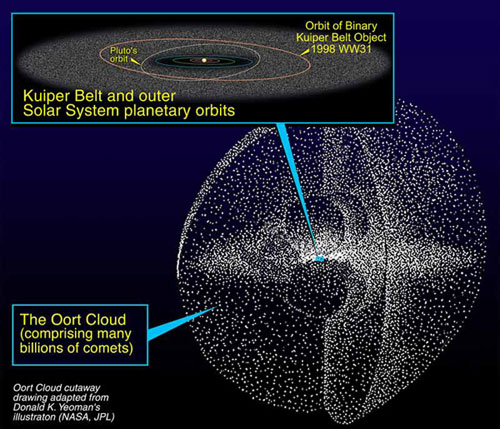
Even that isn't the farthest any object gets on a Solar orbit--lonely Sedna flies even farther, as does Eris. But it's the perihelion (the closest approach) that really has folks interested, though. There are other objects which we know get farther away from the Sun than 2012 VP113 does, but no one has ever observed an object orbiting the sun that stays as far away as it does. In fact, 2012 VP113's perihelion distance is so large it never even comes inside the Kuiper Belt. Its home lies much farther out, in the still-largely-just-theorized Oort Cloud, the home of comets and other objects on hugely elliptical orbits. We know very, very little about this distant collection of icy rocks, so it's exciting to have detected an object that calls it home.

The Oort Cloud, with the Kuiper Belt inset (source).

The Oort Cloud is incredibly big, utterly dwarfing Pluto's orbit--and we don't know for 100% sure that it's even there. There may well be the "many billions of comets" out there that the image above depicts, but they would only rarely make appearances in the inner solar system and detecting such objects at distances in the hundreds--or thousands--of AU is nearly impossible. So discoveries like this one are an encouraging sign that our theories are on the right track. While studying an object like 2012 VP113 is a challenge, to say the least, even knowing that it's out there is a promising hint of discoveries that may be to come. As our equipment and techniques improve, we may well discover that we were exactly right about the Oort cloud--or that the truth is something far more bizarre and fascinating than we imagined.

Molecular Clouds in Everyone's Favorite Constellation

I'll admit right off the bat that I'm being unoriginal with this one. I originally found this image by way of Phil Plait at Bad Astronomy, who called it the best astronomy photograph of 2010 (actually it's a mosaic of 32 photos, all taken by an amateur astronomer, no less!). It is, of course, Orion--perhaps the most recognizable constellation in the sky. But a judicious use of long exposures and filters shows us that there's far more to this constellation than meets the eye.

Click through to the source for various (much) larger versions.

Aside from the stars themselves, the brightest object is M42, the Great Nebula in Orion. Located in Orion's "sword," this nebula (which is visible to the naked eye, even in light-polluted Cambridge) is a 2000-solar-mass molecular cloud which has collapsed into a region of explosive star formation--the closest such region to Earth, and one from which astronomers have gleaned enormous amounts of information about how stars form from collapsing molecular clouds.

Not far away, a pinkish smear lies across the leftmost star in Orion's belt, Alnitak (literally, "the belt" in Arabic--some constellations look like the same thing no matter what culture you're from). Look closely enough at it and you might be able to pick out the silhouette of a horse's head, pointed sideways. Appropriately enough, this is the Horsehead Nebula, another region of star formation connected to M42. Because the process of cloud collapse and fragmentation has progressed so far for M42 and the Horsehead Nebula, each of them feature alternating regions of total transparency and opacity. The opaque regions are dense clumps of gas and dust, soon to form into new stars.

The activity in this photo extends well beyond these two nebulae, though. Perhaps the most dramatic feature of it is the sweeping red band stretching from between Orion's shoulders to his ankles. This is Barnard's Loop, and it's actually a spherical bubble of gas 300 light years across. Barnard's Loop is a chilling companion to the stellar nursery in the heart of Orion--along with that star formation came the dramatic deaths of massive, short-lived stars. At the ends of their lives, they went out with quite a bang. leaving behind this enormous--and still expanding!--sphere of gas.

Continuing up to the top of the image we can see another brilliant cloud of bright red gas, the Lambda Orionis nebula. Despite its brightness, most of the gas in it has already formed into new stars, most of them only five million years old. The open cluster formed from this cloud is easily visible as a dense collection of stars at its center, dominated by a single 28-$M_\odot$ behemoth--Meissa, or Lambda Orionis.

If you look closely at the image, you can see countless other wisps and trails of gas--many of these were once parts of long-dead stars, and likely will be again. But one more easily distinguishable cloud stands out, down in the bottom right. Known as the Witch Head Nebula (the reason for this should be obvious, at least of you turn your screen upside down), it is just barely starting to experience star formation--nearly all of the light that makes it visible comes from mighty Rigel, which--at $18$ solar masses and an incredible $10^{6}$ solar luminosities!--is the seventh brightest star in Earth's sky, and the brightest in Orion.

All of the nebulae visible here are a part of the enormous Orion Molecular Cloud Complex, which encompasses not only these but another half-dozen or so nebulae and molecular clouds which are either out of frame or too faint to be visible here. Ultimately, the existence of these clouds--and the stars that emerge from them--is due to density waves propagating through our galaxy, which give it (along with other spiral galaxies) its distinctive arms. Our own arm of the Milky Way is known as the Orion Spur--seeing just how much is going on in the constellation Orion, it's not hard to see why.

Tuesday, April 1, 2014

The Virial Theorem, Part III: Getting Our Jeans On

Giant molecular clouds occasionally collapse under their own gravity (their own "weight") to form stars. This collapse is temporarily held at bay by the internal gas pressure of the cloud, which can be approximated as an ideal gas such that $P = nk_BT$, where $n$ is the number density of gas particles (with units cm$^{-3}$) within a giant molecular cloud of mass $M$ comprising of particles of mass $\bar{m}$ (mostly Hydrogen molecules, H$_2$) and $k_B$ is the Boltzmann constant $1.4 \times 10^{-16}$ erg K$^{-1}$.

a) What is the total thermal energy of all the gas particles in a cloud of total mass $M$? (HINT: a particle moving in the $i^{th}$ direction has $E_{thermal} = \frac{1}{2}mv_i^2 = \frac{1}{2}kT$. This fact is a consequence of a useful result called the Equipartition Theorem.)

Giant molecular clouds (GMC's) are really the building blocks of a galaxy, even more so than stars. Often hundreds of light-years across, these clouds (which are incredibly diffuse compared to the air surrounding you as you read this but phenomenally dense compared to the truly empty space around them) are what ultimately form into more recognizable arrangements of matter, such as stars and planets--along with everything you might find on a planet. So in a very real sense, you used to be part of a GMC. As an added bonus, GMC's are some of the most impressive-looking structures in space.

The Eagle Nebula, M16, is home to numerous incredibly beautiful and intricate structures of gas and dust, including the famous Pillars of Creation. This spire is located nearby (at least, nearby on a galactic scale) in the nebula (source).

As the setup of this problem explains, a given particle's thermal energy is equal to the sum of its kinetic energy in each degree of freedom. Since we live in three-dimensional space, this means that a single gas particle in a molecular cloud has thermal energy $\frac{3}{2}mv^2 = \frac{3}{2}kT$; thus, the total thermal energy of the cloud is this quantity multiplied by $N$, the number of particles in the cloud. However, we can define this a bit more specifically, since it's unlikely that we'd actually measure (or be able to measure) each individual particle in a cloud 100 parsecs across. Because all of our particles are likely to be of the same mass, we can state that $\bar{m}\times N=M$, or $M/\bar{m} = N$. Plugging this in for $N$ gives us \[E_{T} =  \frac{3}{2}k_BT\frac{M}{\bar{m}}\]

b) What is the total gravitational binding energy of the cloud of mass $M$?

It's most helpful for me to think of gravitational binding energy as the amount of energy that would be required to take all of the component particles of the cloud and spread them out to infinity--this is equivalent (with signs flipped) to the amount of energy that is keeping the particles bound together, and thus is equal to the cloud's gravitational potential energy. Fortunately, we worked out (in some detail) the derivation of an object's total potential energy here, and know it to be \[\frac{3}{5}{GM^2}{R}\] Of course, this is assuming the cloud is spherical (and you need to look no further than the image a few paragraphs above to know that this won't necessarily be the case), but if we imagine a cloud existing in isolation, away from any other forces that would deform it, a sphere is a reasonable approximation.

The Pacman Nebula (yes, that's its name) looks pretty spherical, right? (source)

c) Relate the total thermal energy to the binding energy using the Virial Theorem, recalling that you used something similar to kinetic energy to get the thermal energy earlier.

As it turns out, the thermal energy of the cloud as a whole is equivalent to its overall kinetic energy. Since we summed over each particle's $x$, $y$, and $z$ velocities, what we've ended up with in calculating $E_T$ is equal to $K$. Thus, we can simply plug $E_T$ into the Virial Theorem in place of $K$.\[\frac{3}{2}k_BT\frac{M}{\bar{m}} = \frac{3}{10}\frac{GM^2}{R}\] This can be simplified a bit, so that what we really end up with is \[\frac{5k_bT}{\bar{m}} = \frac{GM}{R}\]

d) If the cloud is stable, then the Viriral Theorem will hold. What happens when the gravitational binding energy is greater than the thermal (kinetic) energy of the cloud Assume a cloud of constant density $\rho$.

What the Virial Theorem tells us is that the thermal energy and gravitational binding energy are, for a stable cloud, balancing each other out exactly. Thermal pressure isn't powerful enough to diffuse the cloud in the face of gravity, and gravity isn't powerful enough to collapse the cloud with thermal pressure pushing against it. However, if gravity gets the edge over thermal energy, the cloud will begin to collapse. This is the first step toward a GMC beginning to form stars, which occurs when it has collapsed enough that regions become so dense and hot that nuclear fusion begins.

e) What is the maximum mass, $M_J$, that the cloud can have before it collapses? This is called the "Jeans Mass."

The adaptation of the Virial Theorem which we arrived at in part c) describes a cloud whose gravitational binding energy is exactly balanced out by its thermal energy. Thus, solving it for $M$ gives us the maximum mass a cloud of mass $R$ can have before it collapses. This is just a matter of multiplying both sides by $\frac{R}{G}$. \[M = \frac{5Rk_BT}{G\bar{m}}\]However, it is possible to generalize this so that we are not working with a fixed radius, provided we assume a constant density $\rho$. We know that the total mass $M$ is the product of $\rho$ and the volume, $4/3 \pi R^3 \approx 4R^3$ Thus, solving for $R$ gives us\[R = (\frac{M}{4\rho})^{1/3}\] We can plug this back into our equation for $M_J$ in place of $R$, but now we have $M$ terms on both sides, so a bit more algebra is required. Dividing the $M^{1/3}$ term over to the right gives us \[M^{2/3} = \frac{5k_BT}{G\bar{m}(4\rho)^{1/3}}\] Solving for $M_J$ is thus a matter of raising both sides to the 3/2, which gives us a final result for $M_J$.\[M_J = (\frac{5k_BT}{G\bar{m}(4\rho)^{1/3}})^{3/2}\] Any $M$ greater than this will lead to the collapse of the cloud.

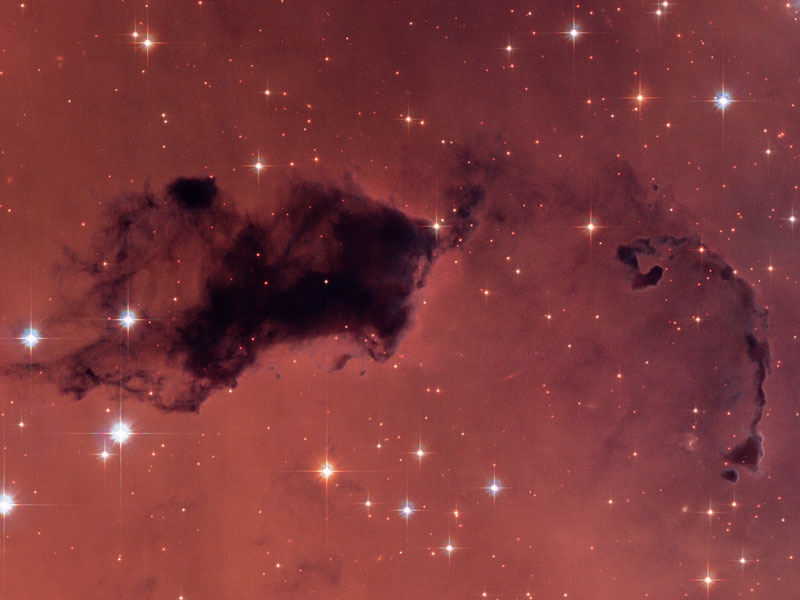
The Taurus Molecular Cloud, first observed and classified by astronomer Edward Barnard as a "dark nebula" (source).

f) What is the minimum radius, $\lambda_J$, that a cloud can have before it collapses? This is known as the "Jeans Length."

We'll follow more or less the same procedure in this part that we did in the last, simply solving for $R$ rather than $M$. Starting again with our version of the Virial Theorem, we can solve for $R$ as\[R = \frac{GM\bar{m}}{5k_BT}\] Once again, though, we can generalize this somewhat further for a cloud of unknown mass using the relation $4R^3\rho = M$. This gives us \[R = \frac{4G\rho R^3\bar{m}}{5k_BT}\] Solving for $R$ at this point is somewhat tricky, but far from impossible. Dividing over the $R^3$ on the right and then taking the reciprocal and square root of both sides clears it all up (albeit with a fairly messy expression). \[\lambda_J = R = (\frac{5k_BT}{4G\rho \bar{m}})^{1/2}\] Any $R$ below this value will again lead to the collapse of the cloud.

To sum things up, I'll apologize for the terrible pun in the title of this post, and again thank my collaborators Anne Madoff and Scott Zhuge.

Sunday, March 30, 2014

The Virial Theorem, Part II: We Are Not Heated By Shrinkage

The Virial Theorem states that half of a gravitationally-bound system's potential energy goes into kinetic energy. It turns out that for a cloud of gas, the other half of $U$ goes into thermal radiation. We  know that the Sun started from the gravitational collapse of a giant cloud of gas. Let's hypothesize that the Sun is powered solely by this gravitational contraction, as was once posited by astronomers long ago. As it shrinks, its internal thermal energy increases, increasing its temperature and thereby causing it to radiate. How long would the Sun last if it was thermally radiating its current power output, $L_\odot = 4 \times 10^{33}$ erg s$^{- 1}$? This is known as the Kelvin-Helmholtz timescale. How does this timescale compare to the age of the oldest Moon rocks (about 4.5 billion years, also known as Gyr)?

The Kelvin-Helmholtz mechanism made an appearance in the last post, where we discussed how it played a role in the heating of exomoons, potentially rendering them uninhabitable. Here we're applying it to our star to see whether, at least when it comes to the age of the Sun, it's a viable way for the Sun to be producing its energy.

If we say that the Sun's thermal emission $E_T$ is equal half of the Sun's potential energy, we can (thanks to the legwork we did in the first post on the Virial Theorem) state that \[T_E = \frac{3GM_\odot^2}{10R_\odot}\] Plugging in the relevant constants gives us \[\frac{3(7 \times 10^{-8}) (2 \times 10^33)^2}{10(7\times 10^{10})} = 1.2 \times 10^{48} \: \: \textrm{erg}\] Now we'll assume that the Sun has been constantly producing its current energy output, $L_\odot = 4 \times 10^{33}$ erg s$^{-1}$. Dividing $E_T$ by this value gives us how long the Sun would last if it were only capable of producing energy via the Kelvin-Helmholtz mechanism.\[\frac{1.2 \times 10^{48} \: \: \textrm{erg}}{4 \times 10^{33} \: \: \textrm{erg s}^{-1}} = 3 \times 10^{14} \: \: \textrm{seconds}\]Converting this to years gives us about $9 \times 10^6$, or 9 million, years. That may seem like a long time, but compared to real geological or cosmological time, it's nothing. If Moon rocks date back 4.5 billion years, then the Sun must too--so something else is powering our solar system.

Not currently shrinking (source).

Frying the Na'vi

In the foreground here is a moon called Pandora:


I should preface everything else in this post by explaining that Pandora is, rather emphatically, not real. Those of you who enjoy poorly-written-but-visually-spectacular movies as much as I do will recognize it as the setting of James Cameron's Dances with Wolves remake Avatar. For those of you who don't, it is worth explaining that Pandora is the habitable moon of a Jupiter-sized gas giant, visible in the background above--it even has an analog of the Great Red Spot, though (like nearly everything else in the movie) it's blue.

Habitable moons pop up all over the place in science fiction, from Avatar to Star Wars to certain works of Robert Heinlein. However, the planet they're orbiting (which is almost invariably a gas giant) seldom exists as more than a dramatic backdrop to the immediate setting. This, as it turns out, is a bit problematic. A recent paper by RenĂ© Heller and Rory Barnes at McMaster University and the University of Washington points out that, while past studies of exomoon habitability largely ignored the evolution of a given moon's orbit and of its parent planet, these factors are critically important over the first billion years after a planet-moon system's formation.

Part of the key to this study is that, as gas giants form, they shrink and cool. Thus, a gas giant in a distant solar system (the study used the example of a 13-Jupiter-mass planet and an Earth-sized moon) would be significantly larger in its early years. Among other things, this would translate to more light being reflected from the system's star onto any potentially habitable moons, which means more energy (and thus, heat) being received by the moon in the form of flux. Combined with this reflected flux is energy produced by the Kelvin-Helmholtz mechanism, where a planet cools and shrinks, then heats up as a result of compression and expels heat (Jupiter produces more energy via this mechanism than via reflected solar flux). Combining this with the tidal heating that all moons undergo and flux from the system's star leads to a lot more heat than past models have evidently accounted for. A possible result of this is that the water on a newly formed potentially habitable moon would begin to evaporate more quickly than it could precipitate. Water is a heck of a greenhouse gas, trapping heat much more effectively even than carbon dioxide or methane. As a result, as the exomoon's water evaporated, it would heat up even more, leading to more evaporation, and so on and so forth in a runaway greenhouse effect--this process is how our sister planet Venus became the scorched hellscape that it is today.

The surface of Venus, imaged by the Venera 13 lander in 1982. The lander lasted for just over two hours, enduring a temperature of 457 degrees C and pressure of 89 Earth atmospheres, before it ceased transmitting (source).

In order to escape Venus' fate, an exomoon must exist in a kind of secondary habitable zone around its parent gas giant (assuming it already exists within its star's habitable zone). The closer to the inner edge of the stellar habitable zone the planet and moon are, the farther from the planet this limit becomes--in the case of the 13-Jupiter-mass planet and Earth-sized moon, the moon can orbit no closer than 28 Jupiter radii (for reference, Callisto, the most distant of the Galilean Moons, orbits Jupiter at a distance of about 26 Jupiter radii). Moons inside of this orbital limit would be in danger of losing any water that might exist on them, along with any chance of being habitable, in the first few million years of their existence. Settling an exomoon is a cool idea, and one we'll no doubt see again in sci-fi movies. But next time you see one, see how close it looks to its parent planet. That should tell you whether the director did his homework.

One last note: over the course of researching this post, I came across this page from the Center for Astrophysics, for a project called the Hunt for Exomoons with Kepler (HEK), which uses the exact same still from Avatar that I did. So minus points on me for unoriginality, but bonus points to CfA researchers for doing some seriously cool research.

It Almost Seems Too Convenient: The Virial Theorem

a) Consider a spherical distribution of particles, each with a mass $m_i$ and a total (collective) mass $\displaystyle\sum\limits_{i}^N m_i = M$, and a total (collective) radius $R$. Convince yourself that the total potential energy $U$ is of the form\[U=-\frac{GM^2}{R}\]

Let's first examine what it is we mean by a "spherical distribution of particles." It doesn't actually matter how densely packed all of these particles are--this could be a globular cluster, or it could be a single star. The key is that all of the component parts--whether they're stars or atoms--are evenly distributed across a spherical volume.

Pictured: A spherical distribution of particles (source).

In order to find the total potential energy of the sphere, we're going to integrate out from the center, summing the potential energies of spherical shells. Gravitational potential energy is defined as $U = -\frac{GMm}{r}$, where in the case of a spherical shell, $M$ is the mass enclosed by the shell, $m$ is the mass of the shell, and $r$ is the radius of the shell. Our first step, then, should be to define each of these terms for a given shell at radius $r_i$.

$G$ is constant, which makes our lives a bit easier. $M_i$ is going to be the volume enclosed by the spherical shell ($4/3 \pi r_i^3$) multiplied by the density of the distribution, which we can describe by dividing its total mass, $M$, by its total volume, $4/3 \pi R^3$ (where $R$ is the total radius). However, for simplicity's sake, we'll just plug $\rho$ into the equation for $\frac{M}{4/3 \pi R^3}$, giving us $M_i = 4/3 \pi r_i^3 \rho$.

Next we need to look at the mass $m_i$ of the spherical shell with radius $r_i$. If we were to integrate by mass, this quantity would simply be $dm$. However, since ultimately we're going to integrate by radius, we need to define it further. We'll take the usual approach when integrating by summing spherical shells and describe the volume of a given shell as its surface area times its width, or $4 \pi r_i^2 \times dr$. Multiplying this by density once again gives us $m_i = \rho 4 \pi r_i^2 dr$. Putting everything together now gives us an equation for the potential energy $U_i$ of a given spherical shell.\[U_i = -\frac{G \times 4/3 \pi r_i^3 \rho \times \rho 4 \pi r_i^2 dr}{r_i} = -\frac{16 \pi ^2}{3}(G r_i^4 \rho^2 dr)\] Now we're going to want to integrate, in order to go from the potential energy of a single shell to the overall potential energy of the distribution--as such, it makes more sense to describe $U_i$ as $dU$ on the left side of the equation. On the right, we're integrating radii from 0 out to $R$, so everything else is a constant that we can pull out. This gives us \[\int dU = -\frac{16 \pi^2 G \rho^2}{3} \int_0^R r^4dr\] The left integral just comes out to $U$, while the right integral comes out to $1/5 R^5$. Including all of the constants, then, we have \[U = -\frac{16 \pi^2 G \rho^2 R^5}{15}\] The last step is to recall that we defined $\rho$ as $\frac{M}{4/3 \pi R^3}$ and substitute back in for it. Once we do so, this mess of algebra quickly collapses into exactly what we were looking for.\[U = -\frac{16 \pi^2 GR^5M^2}{15(\frac{16}{9})\pi^2R^6} = -\frac{9GM^2}{15R} = -\frac{3GM^2}{5R}\] Exactly the form we wanted, with a coefficient of $3/5$ thrown in for good measure. This makes a great deal of sense, since most of the particles in the distribution are closer to the outside (imagine the number of particles in a spherical shell at the edge compared to the number in a spherical shell near the center).

b) If the average speed of a star in a cluster of thousands of stars is $<v>$, give an expression for the total mass of the cluster.

Star clusters are pretty cool objects. They range from tightly bound globular clusters in the galactic halo, composed of hundreds of thousands of ancient stars, to less numerous, looser associations of bright young stars. Of the former, the most famous is probably Messier 13, the Great Globular Cluster in Hercules, while of the latter the most well-known is almost certainly the Pleiades, a collection of brilliant blue stars in Taurus.

The Great Globular Cluster (source) and the Pleiades (source).

In order to figure out the mass of our cluster, we're going to use the Virial Theorem to which the title of this post refers. The Virial Theorem is both deceptively simple and incredibly useful. All it states is that the kinetic energy of a collection of matter bound by a force that follows an inverse-square law (gravity is a good, and applicable, example of such a force) is equal to half of its potential energy (multiplied by -1). In math-ese, this means that\[K = -1/2U\]. Now we need to apply this to the problem at hand. We know the potential energy, since we found that in the last part: $-\frac{3GM^2}{R}$, where $M$ and $R$ are the mass and radius of the cluster, respectively. The total kinetic energy, meanwhile, is the number of stars (which we'll call $N$) multiplied by the average mass of a given star, $m$ and the average velocity of a given star--$v$ (all multiplied by 1/2). All of this put together and plugged into the Virial Theorem gives us \[-\frac{3GM^2}{10R} = \frac{Nmv^2}{2}\] Now it's just a matter of solving for $M$--which is substantially easier when we note that $N \times m = M$, allowing us to cancel an $M$ from each side. A few algebraic steps give us a final expression for $M$.\[M=\frac{5Rv^2}{3G}\]

c) The cluster M80 has an angular diameter about 10 arcminutes and resides about $10^4$ parsecs from the Sun. If the average velocity of a star in M80 is $<v> \approx 10 \textrm{km s}^{-1}$, Approximately how much mass, in solar masses ($M_\odot$), does the cluster contain?

Our first step here is to figure out the radius of the cluster, which we can do using its angular diameter and distance by solving the very familiar small angle approximation $\theta=2R/D$ for $R$, where $\theta$ is the cluster's angular diameter, $D$ is its distance, and $R$ is its radius. We can then plug in $\frac{\theta D}{2}$ in for R in the equation we derived for $M$ in the last part, giving us $M = \frac{5\frac{\theta D}{2}v^2}{3G}$.

The cluster M80 in Scorpius. M80 is notable for containing numerous blue stragglers, one of which is easily visible just to the left side of the main body of the cluster (source).

From here, it's just a matter of inserting values for each of the constants and solving out (remembering to convert $10$ arcminutes into $3 \times 10^{-3}$ radians, $10^4$ parsecs into $3 \times 10^22$ cm, and $10$ km/s into $10^6$ km/s). This gives us \[M = \frac{5\frac{3 \times 10^{-3} \times 3 \times 10^{22}}{2} (10^6)^2}{3G} = 10^{39} /: /: \textrm{g} = 5 \times 10^5 \: \: M_\odot\] According to Wikipedia, this is dead on--score one for the Virial Theorem.

Credit goes out once again to Anne Madoff and Scott Zhuge for working through these tricky problems with me.

Saturday, March 29, 2014

The Ideal Gas Law, Free-Body Diagrams, and the Interiors of Stars: Hydrostatic Equilibrium

A Hydrostatic Haiku:
Gravity Pulls Down
Down, Inexorably Down
P briefly impedes

Consider the Earth's atmosphere by assuming the constituent particles comprise an ideal gas, such that $P = nk_b T$, where $n$ is the number density of particles (with units cm$^{-3}, k_b = 1.4 \times 10^{-16}$ erg K$^{-1}$ s is the Boltzmann constant. We'll use this ideal gas law in a bit, but first:

a-b) Think of a small, cylindrical parcel of gas, with the axis running vertically in the Earth's atmosphere. The parcel sits a distance $r$ r from the Earth's center, and the parcel's size is defi ned by a height $\Delta r < < r$ and a circular cross-section area A. The parcel will feel pressure pushing up from gas below ($P_{up}  P(r)$) and down from above ($P_{down} = P(r+\Delta r)$).  What other force will the parcel feel, assuming it has a density $\rho$ and and the Earth has a mass $M_\oplus$. Make a drawing of this.

Here, we're looking at a snapshot of an object. At this point, it doesn't matter whether the cylindrical parcel contains gas, the new Kindle you ordered (dropped from one of Amazon.com's drones), or a cylindrical cow. Whatever it is, it has a cross-section $A$ and a height $\Delta r$, and it's in the air--floating, rising, falling, it doesn't matter yet--at a height $r$.

What we want to do now is draw a free body diagram of the forces currently acting on our object. As the problem's setup explains, there's both an upward and downward force exerted by pressure ($P_{up}$ and $P_{down}$). Finally, and perhaps most obviously, there's the force most of us would think of first when considering what'll happen to an object floating in the air: gravity, $F_g$ (which, of course, is another downward force). Here's what it looks like:

Each force is labeled, with the arrows pointing in the direction in which they are acting.

c) If the parcel is not moving, give a mathematical expression relating the various forces, remembering that force is a vector and pressure is a force per unit area. 

Our next step is to essentially treat this like a static equilibrium problem, setting the sum of the upward forces equal to the sum of the downward forces (multiplied by negative one, since they are pointing in different directions) so that the parcel can sit where it is without moving. Pushing down on it we have $F_g$ and $P_{down} \times A$ (since pressure acts on the entire top surface area), while $F_{up} \times A$ is pushing up (again, because the upward pressure is distributed over the bottom surface). So, in its most general form, the expression we're looking for is \[F_g + P_{down} = -P_{up}\]

d-e) Give an expression for the gravitational acceleration, $g$, at a distance $r$ above the Earth's center in terms of the physical variables of this situation. Finally, show that \[\frac{dP(r)}{dr} = -\rho g\] This is the equation of hydrostatic equilibrium. What does it ``say" in English? Does it make sense? 

What we need to do here is figure out exactly what each of the terms in that last equation is. $F_g$ is defined as mass, $m$, times gravitational acceleration, $g$. On Earth's surface, $g$ is right around 10 m s$^{-2}$, but in order to generalize this we need to go a step farther back to the actual equation for $g$, $g = -\frac{GM}{r^2}$. In this case, since we're talking about the Earth, $M$ is $M_\oplus$, so $g = -\frac{GM_\oplus}{r^2}$. Now let's factor this into $F_g$. If we define the density of the gas in the parcel to be $\rho$, then mass is density times volume--or $\rho A \Delta r$, meaning $F_g = -\rho A \Delta r \frac{GM_\oplus}{r^2}$. However, for visual simplicity's sake, let's just keep $\frac{GM_\oplus}{r^2}$ as $g$, meaning $F_g = -\rho A \Delta r g$.

Next, let's consider how pressure is behaving and put all of this together. The problem's setup defines pressure as a function of height, $P(r)$, so $P_{up} = P(r)$ and $P_{down} = -P(r + \Delta r)$. Plugging these back into the general equation, we have \[P(r) A= -P(r + \Delta r) A - \rho A \Delta r g\] This can, however, be simplified quite a bit. Let's begin by putting the pressure terms on one side and canceling out each A, giving us \[P(r)+P(r+\Delta r) = - \rho \Delta r g\] Next, let's divide both sides by $\Delta r$, so that we have \[\frac{P(r)+P(r+\Delta r)}{\Delta r} = - \rho g\]This may look familiar to some folks as the definition of the derivative--so the entire left side is actually $\frac{dP(r)}{dr}$!. Thus our final answer, which puts our package in static equilibrium (or, more properly, hydrostatic equilibrium) is\[\frac{dP(r)}{dr} = -\rho g\] This actually tells us quite a lot. The easiest way to think about it is imagining what happens to the equation overall as the various terms change. The denser (and thus, heavier) our parcel is, the more $P(r)$ changes as a function of $r$. If the parcel is in the air over a more massive planet, thus increasing $g$, $P(r)$ will change more if the parcel gets nudged slightly higher or lower.

Hydrostatic equilibrium is why our Sun, and other stars like it, do not contract due to their enormous gravity, nor do they expand due to the enormous pressure of their interior gas. The forces balance each other out (source).

f) Now go back to the ideal gas law described above. Derive an expression describing how the density of the Earth's atmosphere varies with height $\rho(r)$. Recall that $dx/x = dlnx$.

This is more or less a matter of plugging and chugging. We'll start by solving our final equation above for $\rho$ and plugging in $nk_b T$ for $P(r)$. Before we do, however, let's get rid of that $n$, reflecting the number density of particles, since it's just not a very useful or informative term, and we can represent it in terms of variables we're already using: mass and density (or more specifically, mass divided by density). This gives us \[\rho = -\frac{1}{g}\frac{d\rho}{dr}(\frac{ k_B T}{m})\] Next, let's solve for $dr$ on the left and get all of the constants and $\rho$ terms on the right, so that we have\[dr = -\frac{k_B T}{mg} \frac{d\rho}{\rho}\]. Now we'll integrate both sides to give us an actual function for $\rho (r)$. this is where that hint about $dx/x$ will come in handy, since that's exactly what we have on the right side of our equation (with $\rho$ in place of $x$). What we end up with, then, is \[r = -\frac{k_B T}{mg}ln(\rho) + c\] Where c is the constant resulting from integrating--we'll get to in a bit. However, what we need to do first is solve for $\rho$ (or more properly, $\rho (r)$, first by subtracting $c$ over to the other side and dividing by $-\frac{k_B T}{mg}$, then by raising $e$ to each side in order to get $\rho$ out of that natural log. This gives us \[\rho (r) = e^{-\frac{rmg}{k_B T} - c}\] Finally, we can pull that $c$ out of the exponent and make it a coefficient, and think about what it actually means. When $r=0$, $\rho (r)$ will just be equal to whatever that $c$ is, so really it's reflective of the "initial conditions" of our setup--more properly, $c = \rho_0$. Thus, our final expression is \[ \rho(r) = \rho_0e^{-\frac{rmg}{k_B T}}\]

This pretty neat graphic shows, among other interesting things, the fall-off in density of $N_2$, $O_2$, and $O$ at increasing altitude (source).

g) Show that the height, $H$, over which the density falls off by a factor of $1/e$ is given by\[H=\frac{k_BT}{\bar{m}g}\] where $\bar{m}$ is the mean mass of a gas particle. This is the \scale height." First, check the units. Then do the math. Then make sure it makes physical sense, e.g. what do you think should happen when you increase $\bar{m}$? 

Let's start with the unit check. $k_B$ has units of energy $\times$ temperature$^{-1}$, while $g$ has units of length $\times$ time$^{-2}$. $m$ and $t$ obviously have units of mass and temperature respectively, and $H$ has units of length, so the equation overall works out to\[\textrm{length} = \frac{\textrm{energy} \times \textrm{temperature}^{-1} \times \textrm{temperature}}{\textrm{mass} \times \textrm{length} \times \textrm{time}^{-2}}\] At first this doesn't seem to work out exactly right, until we realize that energy actually has units of its own--mass $\times$ length$^2$/time$^2$, to be exact. Thus, what we actually have is \[\textrm{length} = \frac{\textrm{mass} \times \textrm{length}^2 \times \textrm{time}^{-2} \times \textrm{temperature}^{-1} \times \textrm{temperature}}{\textrm{mass} \times \textrm{length} \times \textrm{time}^{-2}}\] Which simplifies to length = length.

Ok, so our units check out. From here out it's just a matter of setting $\frac{\rho (r)}{\rho_0} = 1/e$ and solving for $r$. First, we'll plug everything in for $\rho (r)$, giving us\[\frac{\rho_0e^{-\frac{rmg}{k_B T}}}{\rho_0} = 1/e\] Then, canceling $\rho_0$ and rewriting $1/e$ as $e^{-1}$ makes that into\[e^{-\frac{rmg}{k_B T}} = e^{-1}\] Finally, we can take the natural log of both sides in order to give us an equality with just the exponents, and then divide by $-\frac{mg}{k_B T}$ to solve for $r$, giving us \[H=r=\frac{k_B T}{mg}\]

h) What is the Earth's scale height, $H_\oplus$? The mass of a proton is $1.7 \times 10^{-24}$ g, and  the Earth's atmosphere is mostly molecular nitrogen, $N_2$, where atomic nitrogen has 7 protons and 7 neutrons.

This is relatively straightforward--all we need to do is calculate the mass of an $N_2$ molecule and plug it into the equation for $H$ we just derived. Two atoms, each holding 7 protons and 7 neutrons massing $1.7 \times 10^{-24}$ g each (neutrons and protons have approximately equal mass) comes out to $2( 2\ times 7 \times 10^{-24} \approx 3 \times 10^{-23}$ g. $g$ can be approximated as 10 meters/s$^2$--or $10^3$ cm/s$^2$ in more-familiar cgs units. We can set $T$ to be room temperature--around 300 Kelvin. Now it's just time to put it all together:\[H_\oplus = \frac{k_B T}{mg} = \frac{1.4 \times 10^{-16} \times 3 \times 10^2}{3 \times 10^{-23} \times 10^3} \approx 2 \times 10^6 \: \: \textrm{cm}\] This is about 20 kilometers, which is pretty high--twice the hight of an intercontinental flight (or of Mount Everest). However, even though the Earth's atmosphere continues up to around 100 km, it gets denser and denser the lower it is (hence why passenger jets need to be pressurized even flying at half this altitude), so 1/5 the total height seems like a very reasonable estimate of the Earth's scale height.

Special thanks to Anne Madoff and Scott Zhuge for collaborating with me on this problem.